Showing posts with label Tecan. Show all posts

Wednesday, August 22, 2012

Robot Updates

As part of ongoing attempts to get the system to work to our liking we run into two problem.

First, many of the steps in our yeast growth protocols use individual pipetting actions for each well. For this reason we have an arm with individual pipettes. Initially we configured the arm with four fixed tips and four disposable pipettes. The fixed tips are easier to use and do not consume plasticware. On the other hand to get perfect sterility we need to use plastic tips.

So far we learned that the fixed tips (with a wash between uses) is sufficiently clean for our purposes. And so we use these a lot. The problem is that the time it takes to "process" a plate (e.g., remove individually tailored amounts per well for growth dependent dilutions) was too long. The main time consuming steps is the tip washing. 

After consultation with Neotec people, we decided to switch two of the disposable pipette heads with fixed tips. This will give us more tips and thus less washes (as the washes are done in parallel and take the same amount of time for 4 or for 6 tips).

Six fixed tips in action
The second problem is much more serious - the robotic manipulation arm kept getting out of alignment. This lead to serious of failure in our longer experiments. The blame fell onto the plate shaker, which we use a lot in our protocol. The design of the shaker has to allow a robotic arm to place/remove a plate, but at the same time hold the plate firmly during the shaking. The solution in the shaker we had was a spring that held the plate in place. Every time the arm came down to the shaker it would press on a lever and release the plate from the spring. Apparently these repeated presses moved the arm out of place (not by much but sufficiently to cause problems)

The solution was to replace the shaker head to one with a different locking mechanism based on a higher stand that kept the plate sitting down. This required adaptation of a solution Tecan built for arms that hold the plate from above (and not from the side like ours).

New shaker head
So far it seems that the system is indeed more stable. It worked for two days without issues and we are counting.

Sunday, May 8, 2011

Tuneups and a small (but important) improvement

The observant readers of the blog would have notice that conspicuous pink block of hard foam showed up at some point. We used it to stabilize the handoff position of the incubator. The problem was that the incubator is shaking (to aerate the plates inside). These vibrations are then transferred to the attached rail. Since that rail is long, it amplifies the vibrations, leading to unstable pickup by the robotic arm.

Sticking a block of foam beneath the rail damped the vibrations. However, the good people at Neotec, where not happy with it as a long term solution. So today they replaced it with a proper support, that is both sturdy and professional.


More than that, Yoram and Moshe also realigned the "LiHa" arm that has individual pipettes. We have been using the four fixed pipettes a lot, but haven't used the four disposable ones that much. These were haven't been properly tuned yet, and now that we started working with 384 well plates this has become an issue.

It turned out that this tuneup required disassembling part of the fixed tips. Aligning the disposable ones, and then realigning the fixed ones relative to the alignment of the disposable ones. 

The alignment involved a special pin that replaces the tip and has to align to a specific point on the work table.

Once the head is aligned, the actual tips are aligned to be straight down. This requires examining from all possible angles and adjusting the small screws at their base.


Wednesday, May 4, 2011

Hotels in actions

Last week we installed a new external hotel to hold plates. Yesterday Shai Kaplan and Assaf programmed the KiNEDx to recognize the hotel coordinates. Today Assaf put the new device to use by building a program to perform cherry-picking from individual wells from the whole yeast library. Thus, saving himself the need to go into specific wells in 16 plates, each with 384 wells.

The program worked nicely, and we can see a short part of it in this movie.


We did learn few important lessons about hotels. First, manually loading places onto it can be tricky. If you are not careful it is easy to drop a plate. Second, the installation is a bit too close to the KiNEDx rail, and so we might try to move the hotel back a bit.

In addition, Assaf will try to parallelize the program so it brings the next plate while working with the previous one, and so on.

Monday, January 3, 2011

Growing yeasts (Robotically)

The first task we set to do with the robot is grow yeast cells for experiments. This sounds easy? No?

To understand the issue. Lets review the typical yeast life cycle. Suppose you pick a small number of yeasts from a colony or a saturated culture and put in a fresh "rich" media with glucose (sugar). Moreover, suppose that the media is kept in nice temperature (yeast like 30C) and shaken to make sure yeast cells and nutrients keep mixing.

Initially it will take the yeast cells time to realize that they are not in the nutrient-poor environment they were in. They will revitalize themselves and prepare to grow. This phase is called lag phase. During this phase the number of yeast cells will not change.

Once out of lag phase the yeast will start to grow on glucose. They will work hard to use this rich source of energy to grow as fast as possible. A typical yeast cell will divide every 90-120 min (depending on the exact conditions and temperature). This period is called doubling time as the number of yeast will double every fixed period. During this phase the yeast will experience exponential growth. For this reason this is known either as exponential phase or log phase (since it looks linear in logarithmic scale). 

After a while the yeast will start exhausting the sugar. If this was bacteria they will stop growing. But yeast has another trick up their sleeve. They switch from using sugar as fuel to using ethanol. During the fast growth phase the yeast use the glucose in a fast way by fermenting it to ethanol. This is what in human metabolism is known as anaerobic metabolism as it does not require oxygen. In nature this trick allows yeast to outgrow the competition (fast growth) and also kill it (by increasing ethanol concentration). Humans learned long time ago to use this property of yeasts to make alcoholic beverages. 

Returning to the yeast growth, the switch from glucose to ethanol is called the diauxic shift --- the yeast will go through it once it can no longer import glucose from the environment. Ethanol can be used for aerobic metabolism (or respiration), but requires more work to extract energy from it. As a result the yeast will grow slower. They still grow exponentially but the doubling time is much longer.  This phase is often referred to as saturated or early stationary phase although these description are inaccurate as the yeast still grows.

After a while (and this can take much longer), the ethanol reserves are consumed, and the yeast stops growing and enters in to stationary phase. The cells prepare for nutritional hardship and reduce their activity. 

When plot the number of yeasts in the tube during this phases we ideally see this type of curve:


For our experiment we want to take yeasts in the middle of the fast growing exponential phase. Moreover, to make sure that the yeast forgot its history, we want to make sure that there were several (>3) cell divisions since the lag phase. This means that we need to yeast to multiply itself by at least 8-fold from the initial amount.

Moreover, we want to make sure the yeast do not come close to diauxic shift, as this stage results in major changes in the yeast metabolism. This means avoiding over-crowded situation. Finally, we also want to ensure that we have sufficient number of cells to work with, so we do not want under-crowded cells either.

Sounds easy. If the lag phase is 60min and doubling time is say 90min, then we need 330min (5 1/2 hours) to grow the yeast. Calculate the desired amount at the end and seed the culture with 1/8th of that.

The problem is that we want to work with many strains of yeast. In fact, we want to grow 96 strains in one plate. Each strain has different lag time and doubling time. This means that while one strain has 90min doubling time, another might have 150min doubling time. This means that for the latter strain we need 450min to get 3 doubling (8-fold increase), but by then the fast strain has two more doublings and has grown by 32-fold from the original number of cells. Due to the exponential growth, small difference in growth rate can lead to dramatic differences in cell concentration.

So, how do we deal with the problem? Ideally, we can measure the relevant times for each strain and then plan the initial seeding to get things right. In fact, this is what we do, but using a robot.

During the last two weeks, Assaf and Avital developed a robotic protocol that grows the plate of yeast for 20 hours. Every half hour the robot took the plate out of the incubator, and put into a plate reader (spectrophotometer for plates) that measures the optical density (roughly equivalent to number of cells). After this incubation time most wells were past the diauxic shift. The program then used the plate to seed a new plate and again monitored growth for several hours. At this point Assaf and Avital's program computed what dillution it need to perform to each well to ensure that at the planned target time the cells will rich a desired density. The robot then applied a customized dilution step for each well.

At the end of this procedure we had a plate with 96 strains (with very different growth characteristics) all in roughly the same density. To our surprise/relief/joy the robot did all of this without a fault.

The end result can be seen like this. In this graph OD corresponds to yeast density, and each curve describe the density in one well on the plate. You can see the yeasts growing fast and then slowing down. You can also see the two dilution steps (the first dramatic one and then the "correction" step). Most importantly you can appreciate that in the end all the wells are fairly close to each other in density.


The nice growth can be more easily seen in a log-scale plot:


For some reason the empty wells (that do not grow :-) misbehave after the dilution step. Do not that before the final dilution there is a large variability in the density and that it mostly removed by the program.

And so now we can start doing experiment with tightly controlled yeast growth. Yey!


Monday, October 25, 2010

Robot is (finally) installed!

After two delays, today was finally the day. Early in the morning Udi and Arik from Neotec showed up for installation. After re-checking that the tables are flat, we set out to install the robot.

The first step was to unbox the robot from the huge shiping box.


All empty space inside the device was full of a box with various accessories. It took a while to realize that we don't have any hope of pulling it out as one box, and we resorted to removing the contents one-by-one.


Now we could start seeing the shape of the device, Tecan Evo 200, and admire it.


Next, Udi and Arik connect special handles to the robot frame.

We recruited Alon from the lab and Ayelet and set out to lift the Tecan (220kg according to Udi) onto the smallish cart that the Neotek people brought with them. 


Somewhat surprisingly, the cart held the weight, and we slowly moved the procession into the room and next to the table.


A bit of a coordinated heave, and the Tecan was on the table. Few more adjustments and it was located into place.


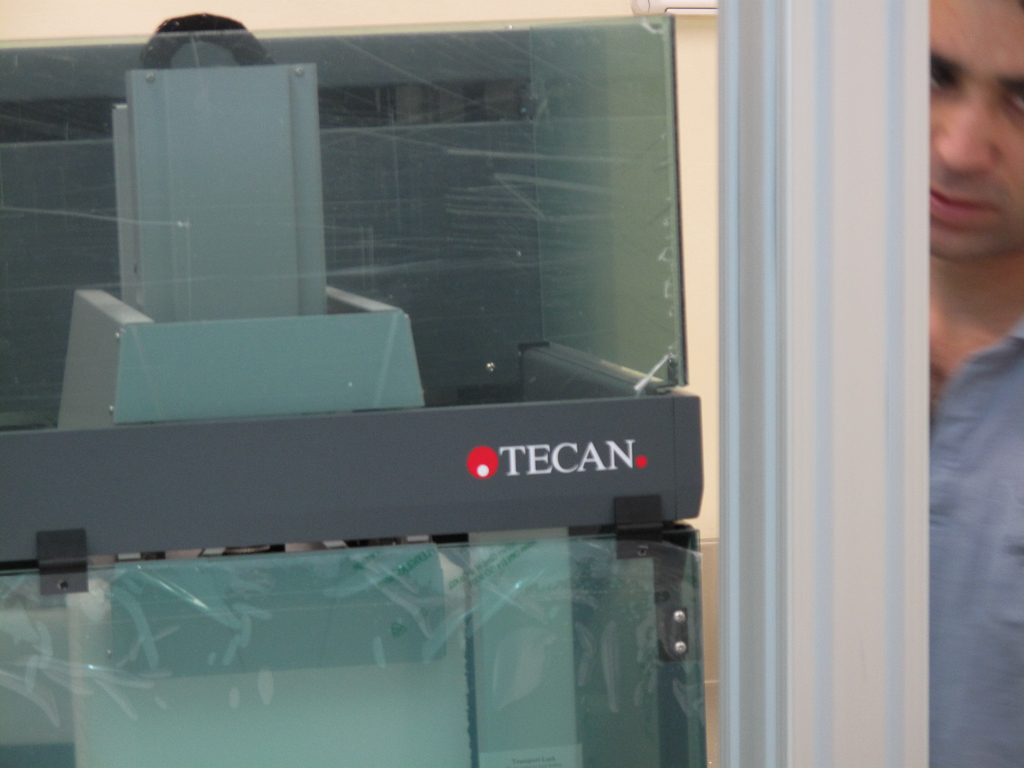
The curious people could now examine the details of the labels.


We then had a small unwrapping ceremony where we got a chance to remove all plastic protectors from the robot outer shell. 


Shy, who is the main software integrator showed up and joined the party. Arik set out to installing the device. This involved removing safety brackets and unlocking the  arms. It didn't take long for him to get to a stage where he set the device on a "Random Walk" mode. In this mode the robot tries moving the arms to different X/Y/Z locations to see that there are no obsticles or mechanical problems. It was fun to watch and gave a good impression of what the machine can do.

While the main Tecan was playing at random walk, Udi and Arik started assembling the movable arm. Its called Peak Robotic KiNEDx. It has a flexible gripper that can hold plates and move them from the Tecan to the microscope.


Once Udi managed to get the arm to move, we tested how far it can reach. We had to move the microscope a bit, but now the stage is in reach of the arm.
During this whole procession, Shy started working on interfacing with the external device. He had a quick success in interfacing with the microscope and in no time managed to show that he can control it from the driver he wrote. So, we are hopeful that the integration would be smooth.

And finally, the obligatory stop-motion film of the day's highlights. Given requests from the audience, I edited the sequence to be short and include the main interesting points. Enjoy!