Showing posts with label robotic room. Show all posts

Wednesday, April 27, 2011

Hotels!

One of the big issues in running large experiments on the robot is managing plasticware. As the experiment progresses we need to use new plates, and these have to be stored somewhere until then.

To solve this issue, we decided to introduce hotels -- racks that can store multiple plates. Since we have an external arm (the KiNEDx), we ordered a hotel that can be accessed by the arm. This allows us to have a larger hotel and make it also more accessible for humans. 

We decided to start with a single hotel to see how it works. Several weeks ago we received it, and then had a meeting with the nice people from the mechanical workshop to discuss how to mount it. Today they showed up with the "stage". It is large enough to hold five hotels in the end. 

After installation, we have a nice hotel standing up. Next, we need to teach the robotic arm to access it.


Sunday, March 20, 2011

Sooner than expected

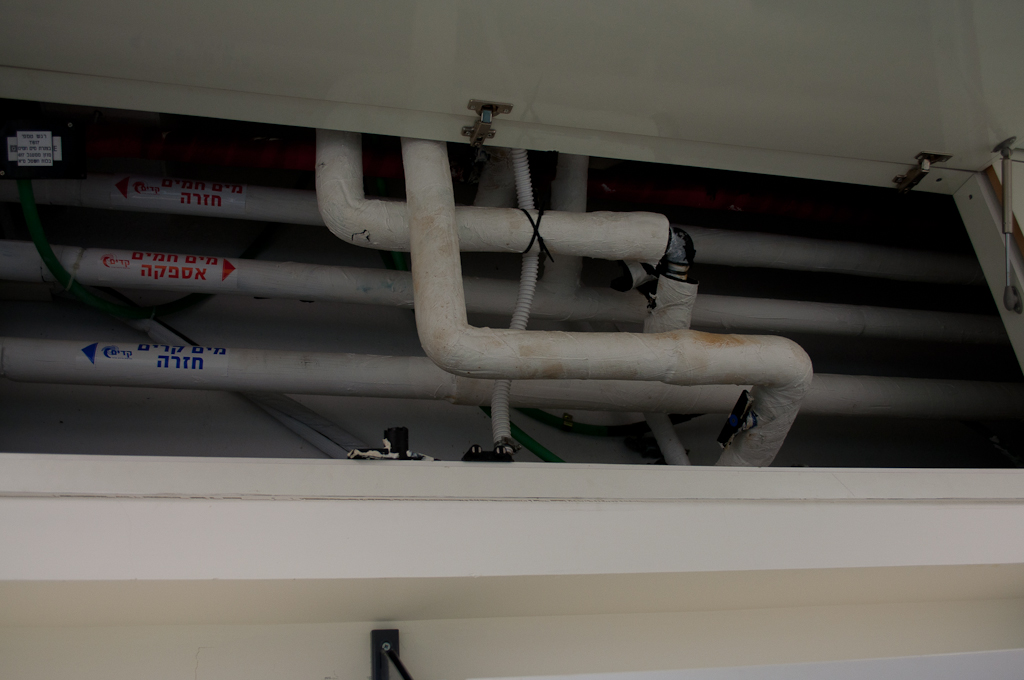
Any installation that involves water flowing in pipes is prone for leaks. We got the first one in our robotic room. Much sooner than we would have hoped.

In the middle of a discussion with Assaf I noticed that the ceiling outside my window was "weeping" water .


A quick examination showed that the whole shelve above the window was flooded with water. We tracked this to a leaking pipe in the water-based A/C unit in the robotic room. 


We called the emergency maintenance hotline, and soon someone showed up. He called the person responsible for A/C maintenance who showed up after half an hour. Together they blocked the in & out lines for this unit (and neighboring room) and drained the pipes to avoid additional leakage. 

Update from this morning. The contractor who connected the A/C showed up. The fault was a fracture in valve that connected the old (pre-existing) pipes to the new installation. He replaced the valve, and now we hope that the ordeal is behind us.

For leakage, the damage was quite minimal. We might need paint renewal in few spots, but overall all equipment are intact.

Wednesday, February 2, 2011

Robotic Facility Kickoff

You may recall that we had an event to celebrate the opening of the first half of our lab. Now that the renovation is almost over (only missing few furnitures), we decided to have a more official kickoff. The idea was to say "Thank You" to all the people who helped us build this lab out of nothing.

The last week, Ayelet, Assaf and Avital (also known as "AAA Robotics") worked hard on setting up a demo of the capabilities of the robotic facility. The last two days, I recruited Tommy (who is still waiting for his J1 visa renewal) to help make a movie of this demo. Tommy turned out to to be a capable photographer and has the option of alternative career in the movie business. 

Yesterday afternoon, Naomi and I went to buy cheese, cherry tomatos and strawberries for the event. As usual, the selection of cheeses at our favorite fromagerie was tough, but we managed to negotiate it. This morning, Ayelet bought fresh bread from our favorite baker. We set up tables in the corridor leading to our lab, with sparkling wine, bread, cheese, and red tomatos and strawberries.

Since all the rooms are already in use, we had the event in the small meeting room/kitchen next to our lab. This meant very select company (we had space for 24 chairs). It was very emotional as it was a chance to thank so many people at once.

Moments before the 9:00am, we did a quick test of the demo, and Ayelet decided we needed another plate with YPD (media), so I rushed to do the job.


During the event I gave a short talk about the science we do, and then had a movie about the robot. 


We then moved to the corridor and had a toast. Sadly, the University President had to rush out before the toast. 


We then had real-life tours of the facility while other used the opportunity to chit-chat and catch up. Sometime even serious scientific discussions.


Photography at the event was courtesy of Roy.

Monday, November 29, 2010

Lab news - fixes and PCRs

Today we have quitely marked an important milestone. Itsik and Ami from the "fine mechanics shop" came to fix the Microscope, HyperCyt and KiNEDx rail to the tables. This means that from now we can assume that their relative positions with respect to each other are fixed (and thus the KiNEDx arm can return to the same position reliably). This is also an indication that we are happy with the temporary outline of devices we put down.

We were warned about the difficulties in drilling in the Terspa benchtop we have. It turned out that with a simple drill it was relatively easy to have holes in the benchtop. 

  
Ami threaded the holes, and then screwed in the equipment.


The HyperCyt is held in place by three machined blocks (two in front and one in the back). The Microscope had its holders that allow for screwing into the table and into the microscope body.


Finally the KiNEDx rail has holes in the rail itself, and it was screwed directly into the benchtop without external holders.

While Itsik and Ami worked in the Robotic room, we received a package.


Our new PCR thermocyclers. We got a deal on a pair of devices from Bio-Rad that combine 96-well head with two 48-well heads under a single controller. This was one of the missing large equipment on our "to get" list.

Thursday, November 4, 2010

HyperCyt and Python Scripts

Today we had a long day in the robotic room. Yesterday Arik from Neotec came to calibrate the find details of the liquid handling arms on the Tecan which solves some issues we encountered on Tuesday.

Today Shai, who is responsible for "smart" robotic application came. We had a general discussion about different ways of integrating software to the robot controlling software. Afterward he, Avital and Assaf sat down and implement some pythons scripts that call the robot and others that the robot can call.


It seemed that this was very fast pace study as they reported success, and managed to fancy pipetting procedures on the fly.


In the meantime, Ariel and Jenia tried to get the HyperCyt to work in the new location. We decided to move the peristaltic pump onto the hypercyt deck. This however resulted in the arm pushing the pump off when the device was initialized. This was annoying, especially since the pictures of the device showed the pump sitting exactly where we put it. 


We searched the manual high and low, and finally realized that one of the figures mentions an L-shaped piece that serves as a stopper in such a configuration.  We used this as evidence that this is the right solution and installed the stopper, which indeed solved the problem.


However, now the coordinates of the arm were totally off. And so we learned how to "teach" it where the different locations are. This involved moving the tip of the needle very slowly with mouse controls until it was in the right location.

In the end the system was working, and we even managed to film it. As you can see the sampling needle goes into each well in succession. This means that it creates alternating bubbles of media (+ cells) and air in the tube. If you look carefully in the movie you can see these tubes.


After lunch break and group meeting Jenia run his nifty analysis software to break the long FACs stream of events to specific wells. It worked like a charm and immediately gave him detailed summary of each well. The investment in this software was definitely worth while.

Sunday, October 24, 2010

Flat Out Tables

And so the Saga continues. We still don't have a robot installed. It was a relief to find it waiting in the corridor in the morning. Or as Moran said, the good news it is still there (no one took it) and the bad news is that it is still there (no one installed it).

The crew from PVPlast who were supposed to fix the tables got stuck on the climb to Jerusalem. They managed to get here by re-filling the car heating system with water. When they got here it took a while to convince them that there was an issue, and then how to solve it.

In the end, we to go through several rounds of examining the tables with a long metal ruler until I approved their work. This took three hours and by then it was clear that the robot installation is not going to go as planned.

I give you the "dance of the flat tables"


On other news, we had Ariel, a dedicated reader of the Blog, visit in person. To make sure this is not lost on the crowd here is the relevant images from the movie.

Tuesday, October 12, 2010

The stage is almost set, waiting for the actors

After long period of very slow developments, the last two days saw frenetic activity. I am away on a trip to Edinburgh (to attend the International Conference on Systems Biology), and so had to hear about the developments by remote control. All the images here were taken by Assaf, serving as my remote eyes.

Yesterday bright and early (before anyone showed up to work) the nice people from PVPlast came in and start installing the work-benches for the robotic room. The design was non-trivial, but they delivered it perfectly. By 2pm they finished and left.

Today, we had the electricity contractors come in to finish the electricity installation, as there is a non-trivial amount of electric/communication outlets that are mounted on the workbenches. 

Few pictures of the work as it progressed today.


The table with the hole is going to hold the robotic-arm-on-a-rail. (The hole is for throwing out used plates.) The table next to it is the "heavy" table for the microscope. This table is not attached to any of the others to avoid vibrations. The bench next to wall is going to hold the microscope monitors and control boxes.


Here we see the tables where the liquid handling robot will sit and the FACS. The table that run in angle to them is the robotic arm table, and in the foreground we see the corner of the microscope table. The clean hood is sitting over the liquid handling table and the end of the robotic arm table, and will enclose this area with super-clean air. The long hole between the two tables will serve for cables. In the background you can see the workbench that will serve for sample preparation, and might also hold some of the equipment monitors. Here is another view of this bench and the clean hood.


Since there many devices will sit on these tables we needed to supply them with electricity and communications. Thus, there is an electricity panel below the robotic table (all along its length).


These cable come from connection boxes along the wall. Thus, there is another panel between the long arm table and the robotic table.


From there the cables go down below the microscope table and all the way to the wall. From the side this look like this.


At the other end of the microscope table the cables come from the rack into another panel. The important part of this construction is that the rack itself is "floating" below the microscope table without actually touching it (so not pass any vibrations).


On the wall the cables are distributed to the various connection boxes (each one housing cables fed from the main electricity and communication boards.

While they were here, the electricians also installed the benchtop lights that we have been waiting for for a long time. Let there be light!


Tuesday, October 5, 2010

Clean Tent

One of the main worries regarding the robotic setup is contamination from the environment. Since the robot works with media and open plates, such contamination can ruin many experiments. We started by thinking of housing the robot in a clean room. This however was very expensive and would require harsh operating conditions. The solution we came up with is to have the robotic room over-pressurized, so that dust and contaminants are pushed out. In addition, the robot parts that involve sterile work will be housed inside a "clean tent".

Today the tent arrived, in pieces.


The technicians quickly assembled the heavy aluminum framework (which was interesting to watch).


Then they loaded on top of it the filter units. 


Each unit filters air through a series of filters and pushes it downwards. As a result the insides of the tent are continually "washed" by very clean air and kept clean. To close off the relevant volume, the tent has plastic sheet flaps that allow access inside but keep the bulk of the clean air going down in a laminar flow.

The next week the tables and benches for the robot will be installed, and then the stage will be set for the main player.