Showing posts with label Dry Ice. Show all posts

Friday, March 18, 2011

Dry Ice Shipping Revisited

After the catastrophic results of our last attempt to send samples on dry ice, we went back and did research on packaging materials for ice. We learned that we need to use foam and strings as plastic tend to be brittle. We also checked various tubes to see how they hold up in cold temperature.

We finally selected tubes that were less brittle and better packaged in their box. Only the larger version was available, and so we ended using tubes that were much larger than needed, but we decided that this would not harm the content.

Assaf re-run the whole experiment again. This time it went smoothly and he got samples without any probelms (so we do learn from experience).

This time each box was padded both inside and outside, and securely wrapped in foam. 
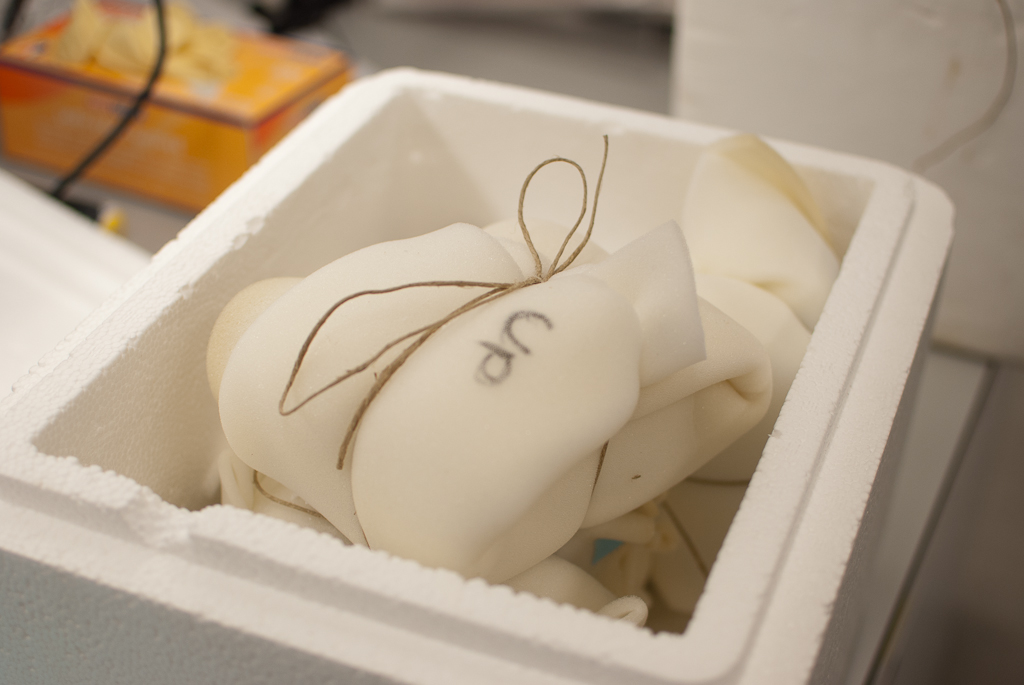

We then packaged them in the box, and wedged them into place with pieces of styrofoam. We broke the big blocks of dry ice to small piece to ensure that there is no big hard mass bumping around during shipping. Since we didn't have a large box, we sent the samples in two separate boxes.


To our relief, the two boxes arrived safe and sound.


Thursday, March 3, 2011

It is a cold harsh world: Lessons in shipping with dry ice

Two week ago Assaf completed a large scale experiment with the robot. The next step was sending all the samples to Ollie's lab for running the NanoString assays. This involved sending cellular extracts with RNA from ~900 samples. Since the samples are sensitive, they need to be kept cold, and so should be shipped expediently packaged with dry ice to keep the temperature.

It turned out that this is a non-trivial exercise. In our previous iteration, we learned where to order dry ice. Now, however, we needed a much larger box as we were sending hundreds of tubes. 

Assaf used the robot to move the samples into 12-strips of small tubes, organized in 96-well format by using tip boxes.


Ayelet and Assaf then sat down and labeled the strips and packed them in boxes. They sealed the boxes with parafilm to keep everything in place. 


Assaf and I packed the insulating polystyrene box with blocks of dry ice, and arranged the boxes on top of them. Finally we sealed the box tightly and shipped it to UMass.


After three days, we get an email titled "Disaster!". When the UMass people opened the box they found small rocks of dry ice and many fragments of plastic scattered throughout the box (although few boxes remained intact).


(pictures courtesy of Ollie's iPhone)

The lessons we learned from the exercise is a harsh one. Turns out that the plastic strips we use are extremely brittle at cold temperature. Moreover, parafilm no longer binds when cold. Moreover, as the ice blocks evaporate, there is room for play inside the box, and things start to jump around, leading to havoc.